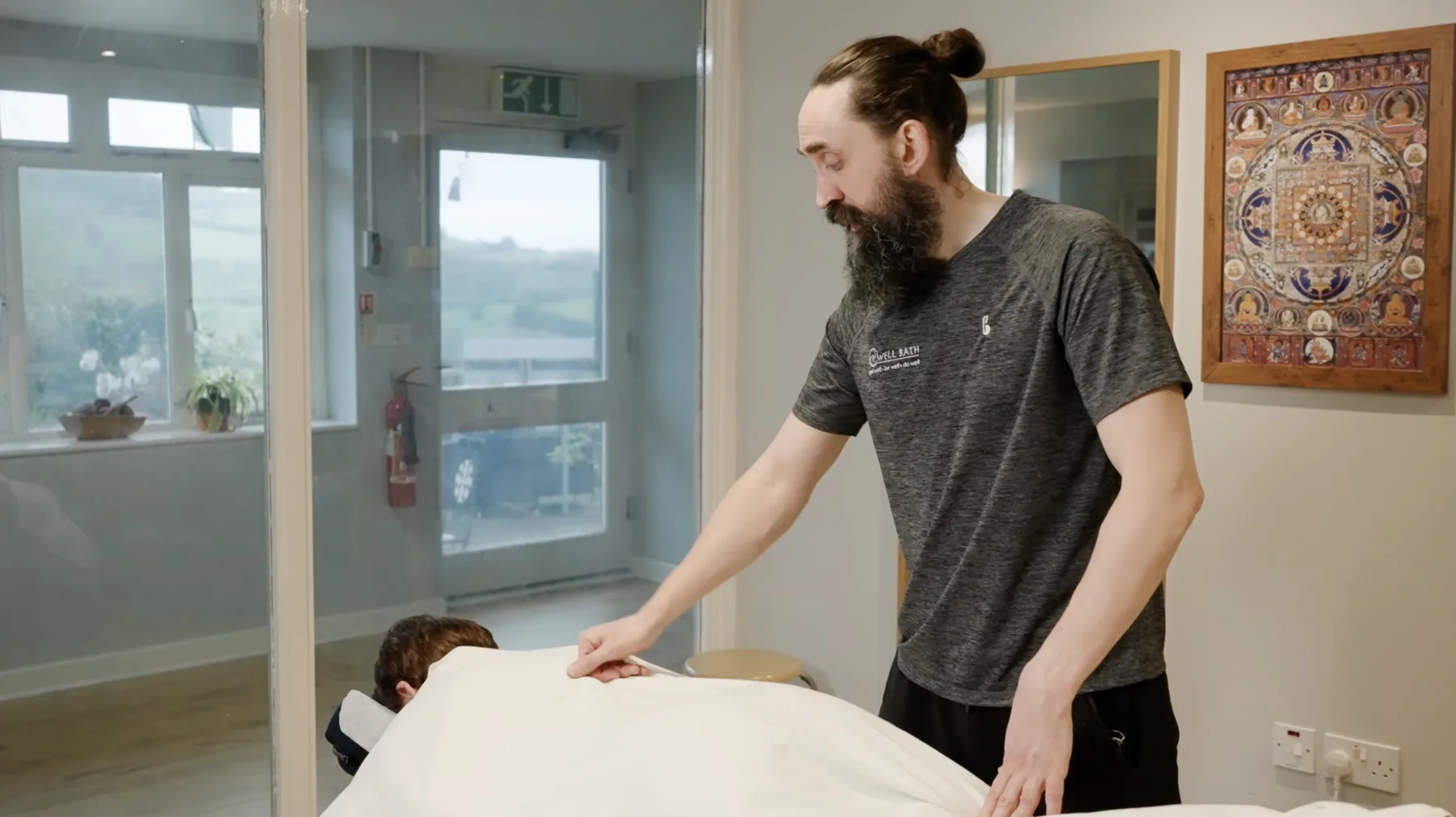
Treatment at Well Bath
Tui Na in Bath
An ancient healing art
The room is warm. You stay fully clothed. Joe works with your body's meridians through pressure, patience, and precise contact. Tui Na is an ancient healing art with over two thousand years of history. It uses key acupressure points on the surface of the body; when these points are stimulated they release tension, increase circulation, and improve the body's natural healing process.
Tui Na also works on trauma held in the muscle, breaking down knots and scar tissue at the local level to increase the flow of blood, nutrients, and oxygen. It is recognised in China as a distinct medical system in its own right, sitting alongside acupuncture in the traditional Chinese medicine framework, but reaching through touch rather than needles.
Joe trained in Tui Na under Errol Lynch at touchtuina.com. His register is deliberate and unhurried, and Tui Na pairs well with cupping if you want a longer session that reaches the deeper fascial layers.
Watch

Duration
60 minutes
Price
£100
Available add-ons
You can extend the session on the booking page
- Cupping £50 · +30 min Traditional glass or silicone cups added to the session for chronic tightness that hands alone cannot reach.
- Hot Stone Massage £100 · +60 min Basalt stones warmed in water, held into the body to reach deeper muscle layers.
- 1 hour extra £100 · +60 min A full extra hour for a longer, deeper session.
- Treatment Extension (short) £25 · +15 min
- Treatment Extension (long) £50 · +30 min
What people bring
Presentations commonly worked with
Tui Na is a general soft-tissue and meridian practice. The presentations Joe most often meets in the room are physical patterns that have not resolved through rest or stretch alone.
- Chronic neck, shoulder, and lower back tension
- Sciatic patterns and referred pain along the legs
- Frozen shoulder and restricted range of movement
- Repetitive-strain patterns from desk-based work
- Sports recovery and unresolved training soreness
- Headaches with a muscular or postural component
- Sleep disturbed by physical tightness
- Low energy and digestive stagnation read through the Chinese-medicine lens
Tui Na is a traditional Chinese medicine practice, not a substitute for medical diagnosis. For undiagnosed acute injury or unexplained symptoms, see your GP first.
What a session is like
From arrival to the last breath in the room
A first Tui Na session runs sixty minutes from the moment you sit down in the foyer to the moment you step back out of the door. This is what is inside that hour.
- 01
Tea in the foyer
Arrive a few minutes early. Pour yourself a herbal tea from the Welsh dresser and sit for a minute. The valley is quiet.
- 02
Intake and listening
Joe asks a handful of questions about where the body is loud, how sleep and digestion are, and what has changed lately. Nothing is written down that does not need to be.
- 03
Reading before touch
A brief pulse read, a look at the tongue, and a palpation of the key acupressure points and meridian lines. This shapes where the session goes.
- 04
On the table
You stay clothed. Joe works the meridians through Tui Na techniques. The register is deliberate and unhurried. If you have booked cupping or hot stones as an add-on, they are woven in here.
- 05
Integration
A few minutes to sit up, take water, and let the system settle before you stand.
- 06
Simple home notes
One or two lines about rest, food, breath, or movement for the next forty-eight hours. Nothing prescriptive.
By far the best massage I've ever had. Not for the faint hearted, this is some serious and deep work, but even with the fears I have of aggravating dodgy nerves, you feel safe and relieved of a whole load of old stress and tension following one of Joe's treatments.
Ellen, Tui Na client
Weighing it up
Tui Na versus Western deep-tissue massage
People often ask what the difference is. Both reach into soft tissue with real weight. The framework and the way the session is held are the parts that separate them.
| Tui Na | Deep-tissue massage | |
|---|---|---|
| Framework | Chinese medicine. Meridians, organ systems, and pulse-and-tongue reading. | Musculoskeletal. Muscle-group and fascia mapping. |
| Dress | Clothed throughout. Loose comfortable layers. | Undressed to underwear, covered with a sheet. |
| Where the work goes | Along acupressure points and meridian lines. | Direct into muscle bellies and trigger points. |
| Pre-touch reading | Pulse, tongue, palpation of key points. | Physical assessment of the complaint area. |
| Add-ons | Cupping and hot stones sit inside the same tradition. | Sports and orthopaedic techniques. |
| Best if you | Want a whole-system reading alongside touch. | Want direct focused work on a known muscle problem. |
This is a framing guide held with both as equally real. Which one fits depends on why you have arrived.
What the evidence says
Research and clinical literature
Tui Na has a small but growing evidence base within complementary medicine journals. These are the sources most often cited in reviews. The framing is deliberately conservative.
-
Systematic reviews of Chinese massage therapies for chronic low back pain report meaningful pain reduction versus usual care, though the authors consistently call for larger high-quality trials.
European Journal of Integrative Medicine · systematic review · 2017
-
The World Health Organization recognises Traditional Chinese Medicine, of which Tui Na is a distinct branch, within its Traditional Medicine Strategy.
-
A Cochrane review of massage for non-specific low back pain found short-term improvements in pain and function versus inactive controls. General massage review, not Tui Na specifically.
Cochrane Database of Systematic Reviews · 2015
Questions people ask
Before you book
Do I need to undress? +
Will it hurt? +
How many sessions do I need? +
How is Tui Na different from acupuncture? +
Is Tui Na safe in pregnancy? +
What should I do afterwards? +
Can I add cupping in the same session? +
What if I have an undiagnosed acute injury? +
Other work by the same hands
Also with these practitioners
Introductory Wellness Evaluation
A one-to-one conversation with Joe. Where you are, what might meet you, what to try first.
Yin Yoga
Ground-level, long-held postures. Restorative rather than active.
Shamanic Breathwork
A longer session with Joe. For those ready to move through something using breath.
Men's Fire Circle
A monthly gathering. Joe and Robby the fire keeper. A place to speak or to sit in silence.
Cupping in Bath
A traditional companion to Tui Na. Held by Joe.
Hot Stone Massage in Bath
Warm basalt stones held into the body. Held by Joe.
Prana Kriya Yoga
Joe's foundational class. Breath-led yoga in the Himalayan lineage.
Himalayan Hatha Yoga
Joe's traditional Hatha class. Steady, held, and grounded.
Breath and Bhajans
Joe's weekly class pairing breathwork with devotional chanting.
I Ching Consultation
Joe consults the ancient Book of Changes as an oracle in a one-to-one session.
Therapeutic Yoga 1-to-1
Joe's private yoga session tuned to the specific body in the room.
Classical Astrology Reading
A one-to-one classical astrology reading with Joe. Bring your date, time, and place of birth.
If you are arriving from
Tui Na in Bath tends to be met by people carrying
Book
Book Tui Na in Bath
Booking runs on Acuity, direct link below. If you are not sure whether tui na in bath is the right fit, reach out and we will help you find the right first door into the sanctuary.
Prefer to talk it through first? Call Joe on 07986 380327 · Joe will get back to you within 24 hours.
Silo of the sanctuary
Also held at Well Bath
Introductory Wellness Evaluation
A one-to-one conversation with Joe. Where you are, what might meet you, what to try first.
Yin Yoga
Ground-level, long-held postures. Restorative rather than active.
Shamanic Breathwork
A longer session with Joe. For those ready to move through something using breath.