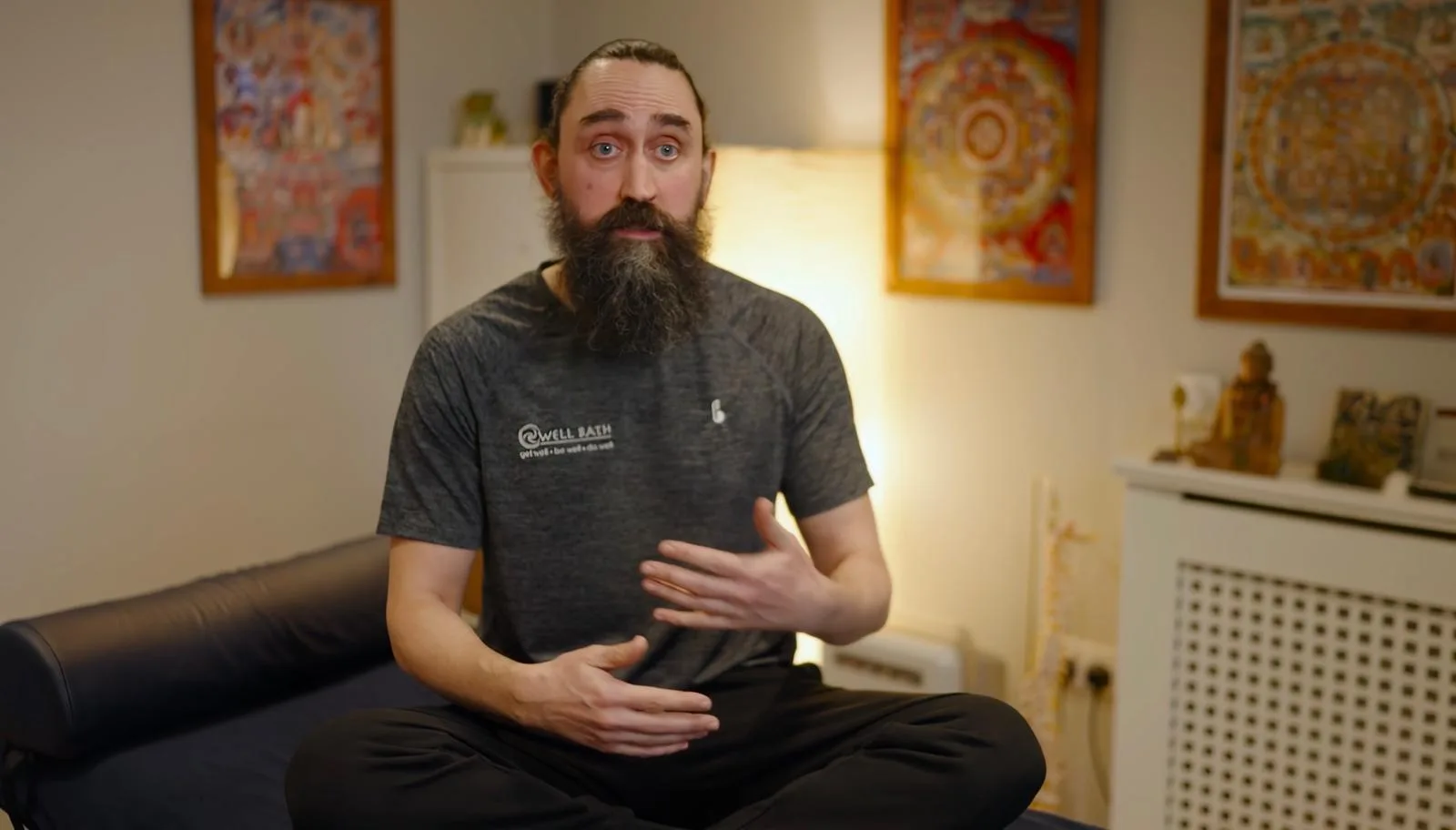
Session at Well Bath
I Ching Consultation
The Book of Changes, consulted for the question you bring
“I came in with a knot I could not name. I left with a shape I could work with.”
You sit across from Joe. You bring a question. The Book of Changes answers not with prediction but with a mirror. The I Ching, the Book of Changes, is one of the oldest divinatory texts in the world. Joe consults it as an oracle in a one-to-one session for the specific question a client brings. The reading is unhurried and interpretive, worked slowly with you rather than performed at you.
Well suited to people at a crossroads, in the middle of a difficult decision, or simply curious about a wisdom tradition older than most religions.
Duration
60 minutes
Price
£100
Available add-ons
You can extend the session on the booking page
- 1 hour extra £100 · +60 min A full extra hour for a longer reading.
What people bring
Presentations commonly worked with
The I Ching is a text consulted rather than administered. People commonly book a session when:
- A specific decision is pressing and the usual weighing has stopped helping
- A pattern in life keeps repeating and there is a wish to look at it from a different angle
- A relationship or a working situation is in transition
- A creative project has stalled or wants direction
- There is no crisis at all, only curiosity about a wisdom tradition older than most religions
The I Ching is a contemplative tool, not medical or psychological treatment. If you are in acute crisis, please speak to a doctor or a therapist first; the I Ching can accompany that work but does not replace it.
What a session is like
From arrival to the last breath in the room
An I Ching session at Well Bath is unhurried by design. The reading itself takes twenty minutes; the sitting-with it is the rest of the hour.
- 01
Arriving
Come through the front door into the foyer. Herbal teas and water on the Welsh dresser — help yourself. Joe collects you when the room is ready. Sessions are held in the therapy rooms at Well Bath.
- 02
Forming the question
The first ten minutes are the honest work of shaping the question you are bringing. Vague questions produce vague readings; specific questions produce clear ones. Joe helps you refine it without steering it.
- 03
Casting the hexagram
The traditional method is three coins, cast six times. Each cast builds one line of a six-line figure. Joe explains what is happening as you go so the process feels present rather than mysterious.
- 04
The reading itself
Joe reads the resulting hexagram — and any changing lines — from a lineage of translations he has been working with for years. Wilhelm and Baynes for grounding, Karcher and Ritsema for the deeper Chinese-to-English work, his own notes for the shape of the specific reading.
- 05
Sitting with what came
The last twenty minutes are yours. What did the reading name? What does it invite? What in it resists? Joe holds the space and offers a light hand rather than an interpretation.
- 06
Taking it with you
You leave with the hexagram number and a short written summary if you would like one. The I Ching often continues to work in the days after a reading; you might return with a follow-up question in a few weeks.
Weighing it up
The I Ching compared with tarot or with modern therapy
Different tools do different things. Naming what the I Ching is and where it sits helps you decide whether it fits what you are bringing.
| I Ching consultation | Tarot / therapy / modern astrology | |
|---|---|---|
| What it is | A Chinese classical text used as an oracle. Structured, symbolic, contemplative. | Tarot: visual archetypal cards. Therapy: modern psychological practice. Astrology: modern psychological reading. |
| How the reading is done | You form a question, cast coins, and Joe reads the resulting hexagram from lineage translations. | Cards drawn and read; conversation over weeks or months; birth chart read against modern archetypes. |
| Register | Considered, precise, sometimes stern. Not designed to comfort. | Varies. Tarot often narrative; therapy relational; astrology often psychological. |
| When it fits | A specific question at a threshold, and a wish for a considered outside view without a person's opinion. | Ongoing self-understanding (therapy), narrative exploration (tarot), personality mapping (astrology). |
The I Ching can sit alongside any of these. Some people bring what came up in a reading into their therapy the following week.
What the evidence says
Research and clinical literature
The I Ching has no clinical evidence base and does not claim any. Its authority is lineage and continuity of use — a document consulted for approximately three thousand years across changing dynasties, philosophies and cultures.
-
The I Ching is one of the oldest continually-used texts in the world, dating from the Western Zhou period (approximately 1000 BCE), and one of the Five Classics of Confucianism.
Rutt, The Book of Changes (Zhouyi): A Bronze Age Document (1996)
-
Carl Jung wrote the foreword to the Wilhelm/Baynes edition, engaging the I Ching as an example of what he called 'synchronicity' — meaningful coincidence — as a philosophical category rather than a truth claim.
Jung, foreword to Wilhelm/Baynes translation of the I Ching (1950)
-
The Wilhelm/Baynes translation remains the most-consulted English edition in the West; the Ritsema/Karcher edition offers a more literal reading closer to the classical Chinese.
Multiple English editions, 1950 to present
Questions people ask
Before you book
Do I need to believe in it? +
What if I don't have a specific question? +
Is this fortune-telling? +
Can I ask about specific people? +
How often should I have a reading? +
Is Joe formally trained in this? +
Other work by the same hands
Also with these practitioners
Introductory Wellness Evaluation
A one-to-one conversation with Joe. Where you are, what might meet you, what to try first.
Yin Yoga
Ground-level, long-held postures. Restorative rather than active.
Tui Na in Bath
An ancient healing art, over 2000 years old. Joe trained under Errol Lynch.
Shamanic Breathwork
A longer session with Joe. For those ready to move through something using breath.
Men's Fire Circle
A monthly gathering. Joe and Robby the fire keeper. A place to speak or to sit in silence.
Cupping in Bath
A traditional companion to Tui Na. Held by Joe.
Hot Stone Massage in Bath
Warm basalt stones held into the body. Held by Joe.
Prana Kriya Yoga
Joe's foundational class. Breath-led yoga in the Himalayan lineage.
Himalayan Hatha Yoga
Joe's traditional Hatha class. Steady, held, and grounded.
Breath and Bhajans
Joe's weekly class pairing breathwork with devotional chanting.
Therapeutic Yoga 1-to-1
Joe's private yoga session tuned to the specific body in the room.
Classical Astrology Reading
A one-to-one classical astrology reading with Joe. Bring your date, time, and place of birth.
If you are arriving from
I Ching Consultation tends to be met by people carrying
Book
Book I Ching Consultation
Booking runs on Acuity, direct link below. If you are not sure whether i ching consultation is the right fit, reach out and we will help you find the right first door into the sanctuary.
Prefer to talk it through first? Call Joe on 07986 380327 · Joe will get back to you within 24 hours.
Silo of the sanctuary