Class at Well Bath
Breath and Bhajans
Breath, sound, and the shared voice
“Everything we do is always about something else outside of yourself, or for someone else. This is the only thing that is just for you, and just about you.”
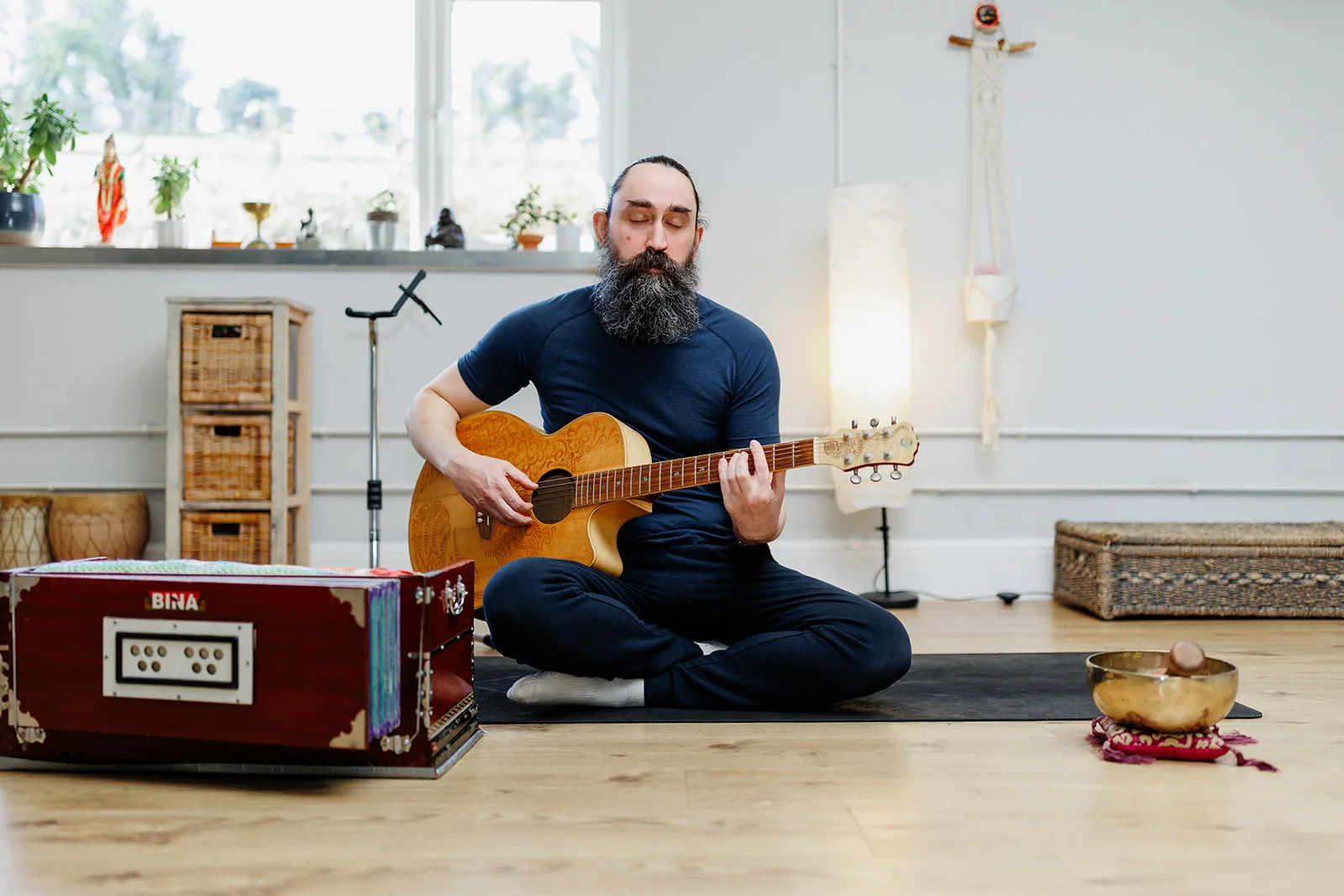
You lie down. Sustained connected breathing settles the body. Then singing rises through the room. Breath and Bhajans is Joe's Friday-morning class at Well Bath. It pairs sustained connected breathing — drawn from the Prana Kriya, Holotropic and Shamanic Breathwork traditions — with devotional chanting (Bhajans) held in Sanskrit and other traditional languages, sung live in the room. The breath opens the body; the sound carries the room; the room carries the practitioner.
You do not need to know the mantras, the language, or how to sing. Show up, lie down, breathe when Joe leads it, and let the wall of sound do the rest. What arrives, arrives.
This is a strong, full-bodied physiological practice that reaches emotional material other approaches do not reach. Most people leave feeling clearer, lighter and slightly reset. Some cry. A few sleep for hours afterwards. All of that is normal.
Duration
90 minutes
Price
See the booking page for current pricing.
What people bring
Presentations commonly worked with
Breath and Bhajans is a physiological practice held inside a devotional container. People arrive with all sorts of things, and the practice tends to meet them where the ordinary week does not.
- Emotional material that will not surface through talk therapy
- Grief needing a container in which to move
- Chronic underlying tension held in the chest and diaphragm
- Creative energy that has become stuck
- Curiosity about altered states, held without substances
- A wish to move through something without having to name it first
- Recovery from burnout where the body still holds the alarm
- Long-term meditators who want a more active complement to sitting
Sustained hyperventilation is a real physiological event. The practice is safe for most, contraindicated for a few. Do not book without a conversation with Joe first if you have cardiovascular disease, uncontrolled hypertension, epilepsy, glaucoma or retinal detachment, are in the first trimester of pregnancy, or have been treated for a psychotic disorder. Joe screens on arrival for anyone new.
What a session is like
From arrival to the last breath in the room
The class runs ninety minutes from 8am on a Friday. This is what unfolds inside that window.
- 01
Arrival
Come early. Tea from the Welsh dresser, sit for a few minutes in the foyer, use the loo, drink water. The class starts on time.
- 02
Opening circle
A short group centring in the studio. Joe checks in briefly with anyone new, names the arc of the class, and takes any last questions.
- 03
Settling on the mat
You lie down, covered with a blanket if you want one, eye pillow available. The room is dim. Joe positions himself in the room; the musicians are already in place.
- 04
Opening breath pattern
Joe leads the first breath pattern out loud. Connected breathing, no pause between the inhale and the exhale, through the mouth. Simple to learn, and Joe teaches it in real time as the class starts.
- 05
The wall of sound rises
As the breath sustains, live music enters. Joe plays harmonium first, then switches to guitar, and sings the mantras himself. Bhajans are sung in Sanskrit, sometimes English. You do not have to sing. The chanting is the vessel that holds the physiological work.
- 06
The full-effort phase
Thirty to forty minutes of sustained connected breathing at pace, with the chanting continuous. This is the physiological centre of the class. Sensations can be intense. Tetany in the hands is common and safe. Emotional material may surface. Let it move.
- 07
Slowing and softening
Joe brings the breath back to natural pace. The music softens. The room integrates in silence, then in gentler chant.
- 08
Rest and integration
Fifteen minutes of savasana. Do not rush to sit up. When you are ready, tea and biscuits in the foyer. A brief informal share with anyone who wants to speak.
When it all opened up, I could see everything, like everything. There was no ceiling, no horizon, and that's when this all started. Time stopped, I could see planets, stars, all moving together with an inner harmony. It was like being at peace with the universe, while actually being part of it all. There was a sense that everything, and everyone, was gonna be alright.
Martin Badder, from his song "Satori"
Weighing it up
Breath and Bhajans versus a one-to-one Shamanic Breathwork session
Joe holds two closely-related pieces of work at Well Bath. If you are choosing between them, this is where they diverge.
| Breath and Bhajans | Shamanic Breathwork one-to-one | |
|---|---|---|
| Container | Group class of ten to twenty people, weekly. | One-to-one session with Joe, booked to your rhythm. |
| Sound | Live musicians and devotional chant, all class. | Recorded music, rattle, occasional live sound from Joe. |
| Length | Ninety minutes. | Seventy-five minutes, with intake conversation either side. |
| Depth of individual attention | Joe reads the room; individual holding is lighter. | Joe stays with you the whole session, tuned to your breath and body. |
| Devotional register | Central — Bhajans are the vessel of the class. | Present if you want it, absent if you do not. |
| Best if you | Want the wall of sound as vessel and the collective field. | Want private work, or want to move through specific material that needs personal holding. |
Many people do both — the class weekly as regular practice, and a one-to-one when something specific is asking for more room.
What the evidence says
Research and clinical literature
The physiological mechanisms of sustained connected breathing are well understood; the therapeutic literature specifically on holotropic-style breathwork is smaller. References below name the mechanisms honestly and cite adjacent studies where the Breath and Bhajans literature itself is thin.
-
Cyclical voluntary hyperventilation reliably elevates plasma epinephrine and can modulate immune response, with training measurable within weeks. This is the well-documented physiological substrate of intensive breathwork.
-
Sustained hyperventilation reduces arterial CO2 and triggers cerebral vasoconstriction on the order of three to four percent per mmHg drop, which is the leading physiological explanation for the altered states of consciousness reached in intensive breathwork.
American Journal of Physiology · Willie et al. · 2012
-
A small pilot on holotropic breathwork found improvements in self-awareness and reductions in trait anxiety in a sixteen-participant sample, tempered by the authors' call for larger controlled studies.
Journal of Humanistic Psychology · Rhinewine and Williams · 2007
An hour and a half of immersive sound and stillness that took me somewhere else. Placing my trust in you, surrendering to the music, chanting and relaxing into my breath allowed me to wander and wonder. It honestly felt like coming home.
Yvette Baker, Breath and Bhajans (Google Local Guide)
Questions people ask
Before you book
Do I need to know how to sing? +
Will I hyperventilate too much? +
Is it safe for my heart? +
What if I cry, or laugh, or shake? +
Will I have visions or hallucinate? +
What should I wear or bring? +
How often should I come? +
Is this religious? +
What are the contraindications? +
Other work by the same hands
Also with these practitioners
Introductory Wellness Evaluation
A one-to-one conversation with Joe. Where you are, what might meet you, what to try first.
Yin Yoga
Ground-level, long-held postures. Restorative rather than active.
Tui Na in Bath
An ancient healing art, over 2000 years old. Joe trained under Errol Lynch.
Shamanic Breathwork
A longer session with Joe. For those ready to move through something using breath.
Men's Fire Circle
A monthly gathering. Joe and Robby the fire keeper. A place to speak or to sit in silence.
Cupping in Bath
A traditional companion to Tui Na. Held by Joe.
Hot Stone Massage in Bath
Warm basalt stones held into the body. Held by Joe.
Prana Kriya Yoga
Joe's foundational class. Breath-led yoga in the Himalayan lineage.
Himalayan Hatha Yoga
Joe's traditional Hatha class. Steady, held, and grounded.
I Ching Consultation
Joe consults the ancient Book of Changes as an oracle in a one-to-one session.
Therapeutic Yoga 1-to-1
Joe's private yoga session tuned to the specific body in the room.
Classical Astrology Reading
A one-to-one classical astrology reading with Joe. Bring your date, time, and place of birth.
Book
Book Breath and Bhajans
Booking runs on Acuity, direct link below. If you are not sure whether breath and bhajans is the right fit, reach out and we will help you find the right first door into the sanctuary.
Prefer to talk it through first? Call Joe on 07986 380327 · Joe will get back to you within 24 hours.
Silo of the sanctuary